
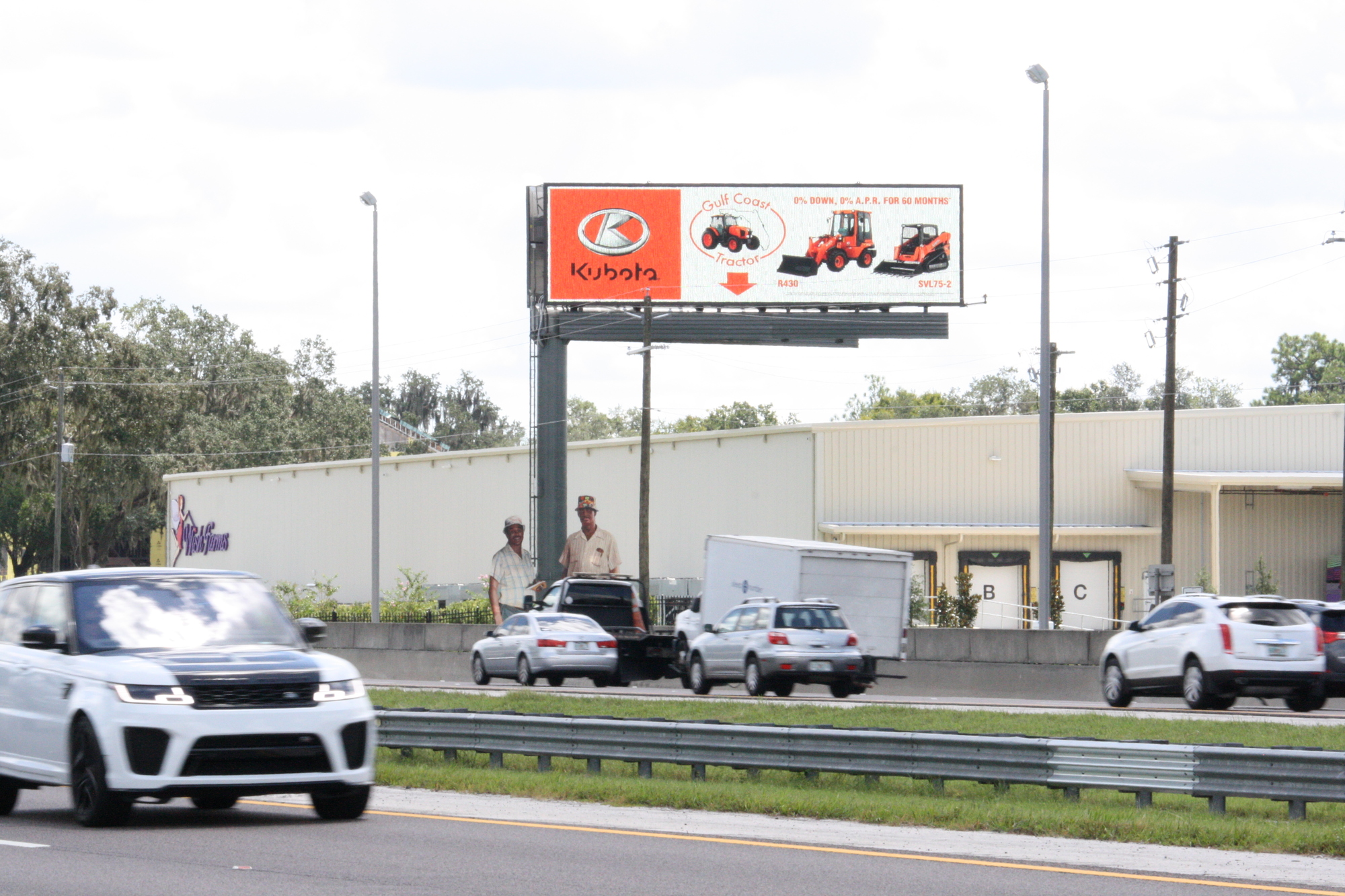

If you drive I-275, I-4, Dale Mabry or the Selmon Expressway on any given day, you pass dozens of billboards. Some are traditional printed vinyl that stays up for weeks. Others are bright digital screens that rotate through several advertisers a minute. Both put your business in front of thousands of Tampa Bay drivers, but they work in different ways, and the right choice depends on your goals, your budget and how often your message changes.
Here is a practical look at how static and digital billboards compare, and how to decide which one fits your business.
What is a static billboard?
A static billboard is a single printed advertisement, usually vinyl, mounted on a structure for a set period, often four weeks or longer. Your ad is the only one on that face for the entire run. Every driver who passes sees your message, all day and all night if the board is lit.
What is a digital billboard?
A digital billboard is an LED screen that displays a rotation of ads. Each advertiser gets a slot, typically a few seconds long, and the loop repeats continuously throughout the day. Instead of buying the whole face, you buy a share of the rotation, and the operator tracks how many times your ad actually played. That tally is the number you see on a proof-of-performance report.
Static vs. digital: how they compare
Visibility and exposure
A static board gives you 100% share of voice. Nobody else appears on that face, so every passing driver has a chance to see you. A digital board shares the screen, but its brightness and motion-free transitions tend to grab attention, especially at night. Digital boards also tend to sit at high-traffic locations, so even a share of the rotation can deliver strong exposure.
Flexibility
This is where digital stands apart. Changing a static billboard means printing and installing a new vinyl, which takes time and money. On a digital board, new creative can usually go live quickly with no production cost. That makes it easy to:
- Promote a weekend sale, then switch back to your brand message on Monday
- Run different ads in the morning and evening commute
- Count down to a grand opening or event
- Test two versions of an ad and keep the one that brings in more calls
Cost
Static boards involve printing and installation costs for each new design, but the space itself can be cost-effective for a long, consistent run. Digital boards eliminate printing costs and let you start with a smaller commitment, which can make them easier to try for a first campaign. Pricing for both varies widely by location, traffic and season, so it is worth asking for a quote on specific boards.
Measurement
Digital billboards can report exactly how many times your ad played and when, which makes it easier to line up your campaign with phone calls, web visits or store traffic. Static boards are measured by estimated traffic counts for the location rather than plays.
When a static billboard makes sense
- You want long-term brand presence in one area, like directional signage for a restaurant, hotel or attraction
- Your message stays the same for months
- You want to own a location outright with no other advertisers sharing the face
When a digital billboard makes sense
- Your offers change often, like retail sales, auto dealers or seasonal services
- You want to tie your ads to timing, such as weekday commutes or weekend traffic
- You plan to update creative for local events and seasons
- You want proof of how often your ad ran
The Tampa factor: timing matters here
Tampa Bay has a busy calendar that rewards timely messaging. Gasparilla, Buccaneers, Lightning and Rays games, spring training, holiday shopping and the winter season when visitors and seasonal residents arrive all change who is on the road and what they are looking for. Digital boards make it simple to adjust your message for those moments, while a well-placed static board keeps your name in front of the same commuters week after week.
Hurricane season is another local consideration. Digital creative can be paused or swapped quickly when storms disrupt plans, such as switching a sale promotion to a “we’re open” or “closed for the storm” message.
Can you use both?
Yes, and many businesses do. A common approach is a static board near your location for steady brand awareness, paired with digital rotations on major corridors to push timely offers. Together they build recognition and drive action.
Tips for an effective billboard, static or digital
- Keep it short. Aim for about seven words or fewer. Drivers have only a few seconds to read.
- Use big, bold type and strong contrast so your message is readable at highway speed.
- One message per ad. Pick a single idea: your brand, your offer or your location.
- Make the next step easy. A simple website, a memorable phone number or an exit or direction works better than a long URL.
- Show your logo clearly so people remember who the ad was for.
Ready to get your business on the road?
Not sure which format fits your goals? Tampa Outdoor can walk you through available static and digital locations across Tampa and Central Florida, help you plan your campaign and design creative that works at highway speed. Contact us to talk through your options.


